A mid-nineteenth century British magistrate whose efforts gave the first modern school to the small city of United Provinces
Text & Pictures by Rehan Asad
Among the four gateways, this western one is in better condition. Though the minarets and many other features were lost. Tthe roof is still intact.The western gateway of Drummond Ganj.
Pilibhit is located fifty-five kilometers south of Bareilly is North Eastern most district of Rohilkhand division, Uttarpradesh, India. In 1879, Pilibhit was created as the separate district from Bareilly. Little is known of the main city before the settlement of Ruhela Afghans especially when Hafiz Rahmat Khan who made it as the capital of Rohilkhand in 1740. Imperial Gazetteer of India, Vol 11 (1886) by Sir William Wilson Hunter wrote about the market Drummond Ganj that was named after a former District Officer having the substantial number of goods shops located at the main part of the city. This beautiful market was built by the British magistrate Honorable R. Drummond at Pilibhit. There were around three hundred twenty shops enclosed in the four gates. The gateways were arranged in a pattern that gave an appearance of the cross. The northern and southern gateways were approximately two hundred fifty meters apart.
The Northern gateway that has been completely lost. Only the few side wall are left as the traces.
The eastern and western gateway were approximately a hundred meters away from each other. Ten meters away from the Northern gateways, the connecting roads to the gateways intersect to form the crossroads.
The eastern gateway that is opening towards the station road and the market around it.
Made up of Lakhori/small bricks and red lime (Surkhi Chuna), the outer plaster has carved floral designs that have been lost in most of the gateways. Each gateway is beautifully designed in an Indo Saracenic pattern with arches, Taakhs, and minarets. The roof has the vaulted appearance but not like a dome.
Only on the western gateway, the roof has been survived. Its made up of small concave vaults supported by iron grids.
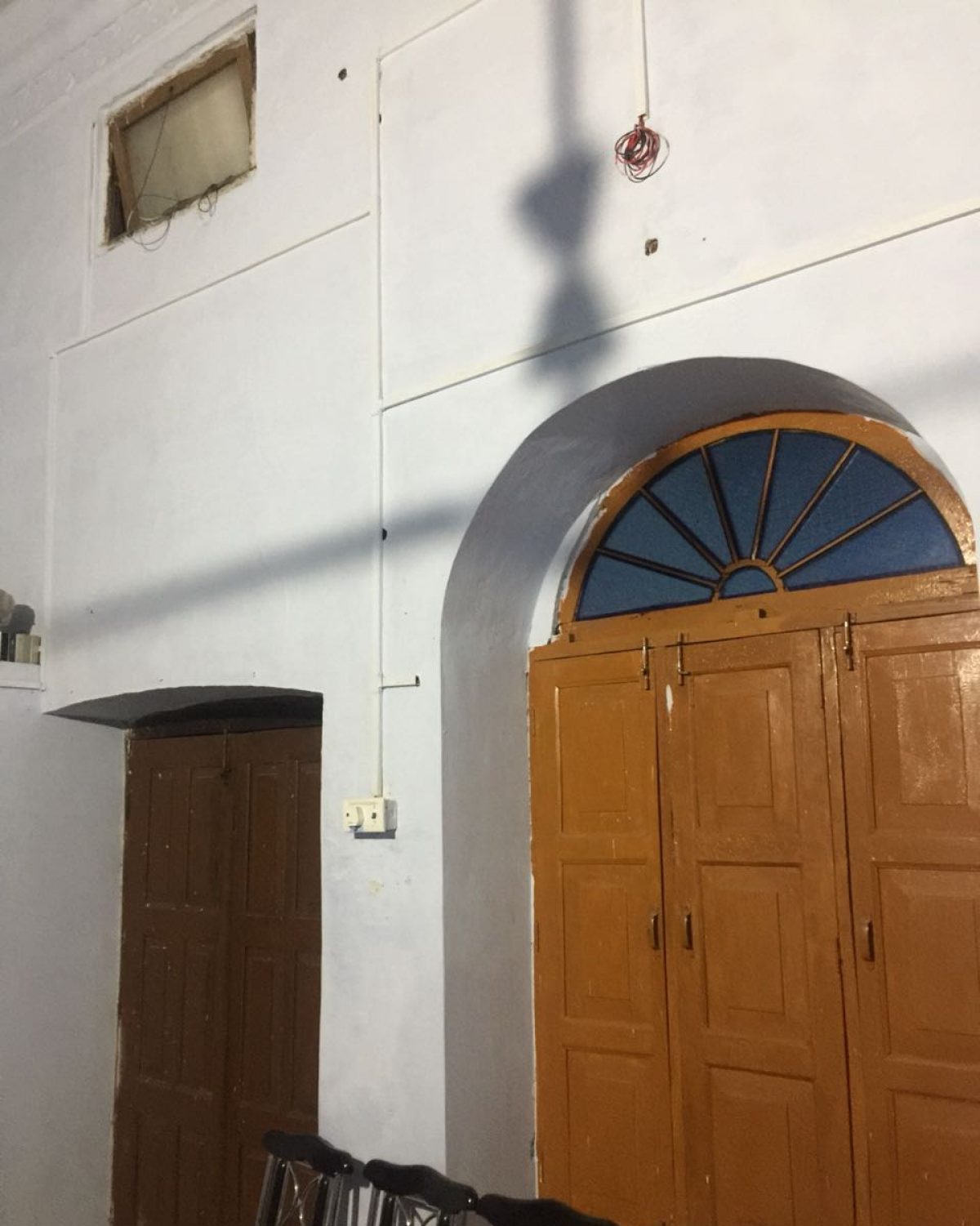
The inner walls of the gateways have the curved enclosures fitted with wooden frames with the doors that lead to the chambers. The outer section also has similar arched curves that have the opening for the windows of the first floor chambers. The income generated from this market was endowed for promoting education among the locals of the community at Pilibhit. I was not able to found the construction date of Drummond Ganj but an approximate idea can be built by the reference where it has been cited. One of the oldest references is the Stewart report of the Public education of North-Western Provinces published from Benares in 1859. The report quoted “The Pilibhit school is maintained by the local funds, the proceeds of the Ganj built by Hon’ble R. Drummond, for many years, the joint magistrate of Pilibhit, Rs 15, the pay of the master of Tahsil, amalgamated with Anglo-Vernacular school is the only item of the expenditure which defrayed by the Government“. From this account it appears, that Drummond Ganj was constructed before the formation of District in 1879 and even before the mutiny in 1857. Mr. Shahbuddin, a senior citizen from Muslim Khatri (Punjabi) community whose great grandfather, Sheikh Jiwan Buksh build a grandiose haveli closeby Drummondganj before 1857 narrated the similar version of its construction as an endowment for the educational cause for the locals. The book life and works of Sir Syed Ahmad Khan by GFI Graham (1885) also reflected on the educational inclination of Drummond. The book cites “In 1864, Hoble R. Drummond presided over an educational meeting at Badaon that was attended by Sir Syed Ahmad Khan and the latter also delivered a speech in the convocation“. Later in 1908, H.R. Nevill Gazette also talked of Drummond Ganj endowment that covers the expense of the Pilibhit School. It was after his great contributions towards the education of the Pilibhit, the government high school and later on the intermediate College was named as Drummond Inter College.
Almost thirty years before during our childhood days, the four gateways of Drummond Ganj were in better condition. The southern gateway that was facing towards the road to Bareilly was popular among locals as “Bareilly Darwaza”. The ground floor has the number of shops occupied by the tenants. The first floor was occupied by registry department issuing death & birth certificates. Among the four gateways, it was completely intact during those days. During the year 1999, I visited this office thrice to get a death certificate of my late maternal grandfather.
The Southern gateways that also houses many government offices till the year 2000. Now completely crumbled. Also popular among the locals as Bareilly Darwaza.
Though shabby and stinky, it was not expected to crumble down completely in the next twenty years. With time, the government offices have been shifted to newly constructed larger office spaces in civil lines. In the last two decade, the vaulted roof has fallen down. The shopkeepers secured their own space but the surroundings of the gateways degraded with time. Most of the shopkeepers sitting in these historic gateways are either Hindu Banias and Muslim Khatris ( Shamsi/Punjabi Muslims) who form the major bulk of trading community from the time of Ruhelas and later on Britishers. When the beautiful building of the first government school was raised in 1915, it was named after Drummond as an acknowledgment for his great efforts.
This building was raised in 1915 as the permanent allocation for the high school. It was named as Drummonds school as an acknowledgment for the great man whose efforts lead to the first school at Pilibhit. After independence, this was elevated to Inter College in 1952.A tablet in the Hindi language hanged in the main hall of Drummonds Inter College. It articulated the efforts of Drummonds to create an endowment from Drummonds Ganj that facilitated in the construction of this school. Though some historical inaccuracies are also noticed in information. It says the school was inaugurated by Hon’ble R. Drummond, the magistrate of Pilibhit in 1915. From the references that I cited in the article showed that R. Drummond was the magistrate of the Pilibhit before 1857.
After independence, it was raised to the senior secondary level and documented as State Government Drummond Inter College. Unfortunately, the local civic authorities became dementic regarding the legacy of Drummond that endowed the money for running the first educational establishment of the city for almost a century ago. This is a real unfortunate face of many crumbling monuments in small cities. A small effort in this direction can help to save our heritage.
References:
Hunter, William Wilson. Imperial Gazetteer of India... Vol. 11. Trumbner & Company, London, 1879.
Henry Stewart Reid, Report on the state of Popular education, in the North Westen Provinces, for 1856/57 and 1857/1858, Published under the authority of the Government, Benares, Medical Hall press, 1859.
Nevill, H.R. (1909), PILIBHIT: A Gazetteer of the District Gazetteers of United Provinces of Agra and Oudh, VolXVIII.
“The Forgotten Cities Of Delhi” a treatise by a noted author & historian Rana Safvi, photographs by Syed Mohammad Qasim, and publication by HarperCollins India was launched at Amazon on 04 May/2018. I was among one of the early readers who booked it on the same day. The beautiful front cover has an endorsement of art historian Catherine Asher & abstract on the flap commenced with the lovely couplet of Mir Taqi Mir cited above. Chapter one started with the title “Siri” covering twenty-four known & unknown monuments located in the premises of Sultan Alauddin Khilji late thirteenth and early fourteenth-century capital built to defend it from Mongols. Every section within the chapter started with the name of the monument, its picture and contextual poetic verse of Urdu/Hindustani & Persian with its English translation. With an architectural description, the text includes the succinct historical accounts, narratives from locals and descriptive citations from nineteenth-century sources “Asar Us Sanadid “& “Archeology and Monumental remains of Delhi”. More or less the similar pattern was followed for all the subsequent chapters in the book. From seventh century Suraj Kund up to the nineteenth century Mirza Ghalib tomb, the manuscript covered a diverse range of monuments located in the five cities of Delhi that came up after Mehrauli. A book two in the trilogy of “Where Stone Speaks“., it’s an outcome of hard work, research, exploration and passionate Journey of more than two years in form of historical trails conducted by author & fellow photographer. In the recent talk with Indian express, while telling tales of Sufi Saint Hazrat Nizamuddin & Sultan Ghyasuddin Tughlaq Shah at Tughlaqabad, she recalled her journey for the exploration of one hundred sixty-six monuments depicted in the account.
I had a great time with the Indian Express team as story telling that too in ruins is my passion. One of the stories in #ForgottenCitiesOfDelhi I've described 166 monuments in the book. https://t.co/AJ4Yjmpd8F
A book excerpt articulating mysteries and stories on the resting place of the 18th-century Persian poet and Sufi Saint Abdul Qadir Bedil published by the @iamrana in@DailyO_.
Similarly, in one of the chapters, the author marked a location as “Mehdiyan” on the site of Maulana Azad Medical College where a fourteenth-century Nawab built an iconic structure to commemorate “Urs” of the Saint of Baghdad, Shiekh Abdul Qadir Gilani. In a similar manner, many unknown monuments and the stories built around it has been recollected in the book.
The last chapter historical trails are the great addon to the book. Its a reflective account of fifteen historical walks in a concise manner depicting the monuments in relation with important landmarks. It will serve as a guidebook for anyone who wants to reach the monuments described in the book. In the changing landscape of growing Delhi, the author also reflected the plight of many monuments ruined by encroachment, illegal human settlements and ignorance of civic authorities. Other than interested readers, the accounts in the book can be used as one reference for the bodies volunteering the monumental protection in addition to ASI. The serene and awesome pictures by Syed Mohammad Qasim (@EvolveLeadLove) gave an enlightenment from the visual perspective to the readers. Short accounts within the sections of the chapters, easy language, and integration of stories made it more interesting while the usage of standard oriental and English reference reflected its scholarly rigor.
The Full Circle Bookstore, Cafe Turtle, and Harper Collins India organized a book launch for “The Forgotten Cities of Delhi” at Greater Kailash I, New Delhi on 22 June. I would like to deliver heartiest congratulations and thanks to Rana Safvi and Syed Mohammad Qasim for the great compilation and upcoming launch.
Note: The translation of Mir Taqi Mir cited above is taken from the account of Rana Safvi “The Forgotten Cities of Delhi“.
The story of honorary magistrate Maulvi Shiekh Abdul Haqq
Text by Rehan Asad| Pictures by Tabish Akhyar
The main entrance to the building. Its located at the start of the western boundary. The passage on this entrance was wider than entrance on the southern boundary wall. The gate at the entrance was removed when some of the sections had been sold out in 1950.The western boundary of the building that now had shops and few flats on the first floor.
Close to the western part of the city, Karghaina building is located in Muneer Khan locality of Pilibhit having around twenty houses, and roadside shops. From its destructured appearance, it’s difficult to visualize, that a century before it was one building. It came into existence in 1902. Built by an Arain landlord, Sheikh Abdul Haqq of village Karghaina whose father held a zamindari estate of three whole villages and shares in many other villages in Pargana Jahanabad. An old grove with an area of approximately four acres existed here that was purchased by Shiekh Abdul Haqq from a Pashtun named Natthu Khan. Born on 27 Dhulqaida 1281 Hijri (1860), he was the eldest son of Haji-Sheikh Qudrat Ali. Shiekh Haji Qudrat Ali stayed at Hijaz for more than three years when he left for the Hajj in 1880. He also stared a Madrassa at Village Karghaina that continued to be managed by his middle son after his death. The eldest son, Sheikh Abdul Haqq was sent to Pilibhit for studying Darse Nizami under the tutelage of great Islamic scholar of the nineteenth century, Maulana Wasi Ahmad who was also known as Muhaddith Surti. A famous Islamic scholar from Rampur Maulvi Salamatullah was appointed for homeschooling of other two sons at village Karghaina. After the death of his father, the villages were divided among three brothers.
A family tree of Haji-Sheikh Qudrat Ali prepared by Tabish Akhyar in 2011. It traced most the descendants. Some of them relocated to Pakistan & USA and Canada.
Leaving behind his ancestral haveli at Village Karghaina, Shiekh Abdul Haqq relocated to the city. It was due to ancestral association with the village, the building was named as Karghaina Building. As an Islamic Scholar, Zamindar and businessman he was quite active in sociopolitical life. He was also nominated by the Imperial government as an honorary magistrate.
The building was constructed as seven separate apartments connected with each other. The entrance to the building was through two paved streets fenced by the gates at the entrance on the western and southern side. The apartments were divided into main residential section (Zenan Khana), baithaks (Guest lodges), and servant quarters. It also had areas in shape of the park for female members, gardens, and section with planted trees of different varieties.
The entrance at the southern boundary of the building. The entrance was bounded by the big gate that has been removed now. Here the road/passage is narrow. This was mainly used by family members. At the end on the right side, a small park was made for the female family members.
In the center of the building, an apartment of around two hundred square yards was Baithak/ Drawing room of Shiekh Abdul Haqq. This apartment can be accessed from both sides. A separate section served as the guest lodge of his only son, Maulvi Anwar Ul Haqq. At the end of the street of southern entrance, a park of six hundred square yards was made close to the female apartments of the building. This was specifically allocated for the females of the household so they could enjoy the walk and relaxed in open air within the building. It has cement benches, fountains and paved galleries. Each of the apartments had the same design. Hall rooms with high ceiling supported with timber and iron grids as a beam.
The verandah (dallan) having similar in design with its front facade supported by the pillars connected by the arches. Then one extended verandah covered by the shade of wrought iron and supported by thin iron rods.
Wrought iron was commonly found in early 20th century North Indian construction. It was introduced in the late 19th century.
Outside a brick-lined courtyard with a raised platform (Chabutra) at one corner. Every apartment has a small area in the courtyard for the plantation of the trees such as pomegranate, guava, mango, and flowers commonly rose.
An element of local architecture of early 20th century. Taakh and a slab below used as a lack for placing items.
One of the small units lying on the left flank of the Western entrance was given to the mason who supervised the construction.
The present occupant purchased it from the custodian properties when he moved to Pakistan in 1947. During the lifetime of Shiekh Abdul Haqq, the building was the center of socio-political activities. The notable Islamic scholar of twentieth-century Imam Ahmad Raza Khan visited Pilibhit eleven times in his life and stayed at Karghaina building as an honored guest of Sheikh Abdul Haqq. My late grandmother who was a small child during those days had faint memories of his stay. After Friday prayers, the scholars, Urdu poets, and other influential people used to have a leisure time at the residence of Sheikh Abdul Haqq. The first annual convocation of the community meeting was held at the same place on 17 February 1917 that was also attended by the envoys sent by Sir Mian Muhammad Shafi from Punjab. During Muharram and Rabiul Awwal feast and congregations were organized at the building. He passed away in 1936 and the funeral prayer was performed by Maulana Hamid Raza Khan, the eldest son of Ahmad Raza Khan. He was survived by one son, Maulvi Anwar Ul Haqq and four daughters. On his death, he left behind a flourishing business, one whole zamindari village, and Karghaina building. Unfortunately, the son was more like a mendicant and low aptitude for managing worldly matters. As a result, he was deceived by many of his close friends. Many time people from close circle asked for the loans in name of performing charity, going for Hajj pilgrimage or joint ventures for new business and losses were suffered on his pocket. Many of the apartments were sold by Maulvi Anwar Ul Haqq after the abolition of zamindari in 1945 to 1950. Most of them were purchased by the zamindars of his community who relocated to the city after the abolition of zamindari system. Maulvi Anwar Ul Haqq passed away in 1963.
This was the residential section of Sheikh Abdul Haqq. The constructed area was around fourteen hundred square yards. Sheikh Usman Hussain a zamindar of Village Udaipur took it on rent in 1945. Later on, it was divided into three separate houses. The main part was purchased by him. His son Mr. Irfan Hussain made some modification. Most of the descendants of Mr. Irfan Hussian relocated to the United States and Canada after attaining higher education from AMU in 1970.
Most of the descendants of second owners had migrated to major cities of India and in western countries after attaining higher education. Some of them also moved to Pakistan in the decade of the 50s & 60s. All of the units had been reconstructed except the two of them that still retained one hundred ten years old construction. One is owned by the descendants of Shiekh Nazeer Ahmad, a wealthy landlord of the district who once owned a Daang estate having more than ten villages. The second one is under the occupation of the great-grandson of Sheikh Abdul Haqq who provided these pictures. This section was taken on rent by the Municipal board to run a female junior high school during the lifetime of Sheikh Abdul Haqq.
The arched facade supported by the thick pillars became the part of a middle-class urban dwelling in the early 20th century. It was imbibed in local architecture from the early days Colonial buildings.
I also had two connections with this place. First I was born and brought up in a house that was once a cultural center of this building, the guest lodge/baithak of Karghaina building. I still remember its thick walls, high ceilings, Taakhs and other elements of old construction. It was bought by my father in 1975 from one of his grandsons. Second, one of the daughters of Shiekh Abdul Haqq was my maternal great-grandmother. The stories of its heydays were passed by my Nani (maternal grandmother) who was the oldest among all third generation descendants of Sheikh Abdul Haqq. As born in 1908, she saw the days of Maulvi Sheikh Abdul Haqq when Karghaina building was one of the vibrant and lively addresses of the town. Maulana Anwar Ul Haqq was survived by four sons and two daughters. The eldest son and both of the daughters moved to Pakistan. From all children’s of Maulvi Anwar Ul Haqq, only two sons are alive and rest of them took a journey to next world. May Allah bless all of them?
This section is located by the right of the southern entrance. Spread over an area of one thousand square yards, it has the garden with plantation of different varieties of trees. The part of it was also used a stable for horses and parking of carts and vehicles.
A reader’s reflective account on “Chandni Chowk: The Mughal city of Old Delhi” authored by Swapna Liddle
Front cover page of the book Chandni Chowk, The Mughal City of Old Delhi
The book “Chandni Chowk” was published by Speaking Tiger Publishing Pvt Limited in collaboration with YES Institute in 2017. The “Walled City/Old Delhi” located in the present urban landscape of National capital region was once a dream project of a monarch to establish it as a new capital for mighty Mughal empire. The oriental accounts referred the term “Old Delhi” for the thirteenth century Mamluk capital Mehrauli, the first city of Delhi. Before the establishment Luytens Delhi, the walled city of Shahjahanabad has a privilege of the term “New Delhi” associated with it. The authors Swapna Liddle treatise on Mughal city of “Shahjahanabad” is a fascinating account articulating its formation, culture, rise & fall integrated with the history of its political transition & turmoil down the centuries. The book started with the story of its birth under Shahjahan, passing over to the puritan Aurangzeb, vulnerable days under forgotten Mughals, its cultural zenith, devastation during the mutiny, post-mutiny transition and its acclimatization with the twentieth century. The rich scholarly content with fine contextual details reflected in the manuscript is reflection of authors doctorate on eighteenth-century Delhi & her great experience of conducting heritage walks in Shahjahanabad. The description of the key events by citing accounts of the contemporaries such as narrations of Bernier and Mannuci in chapter one & two gave the reader an alluring engagement during the journey of exploring the book. The references were cited in the text as superscript in a continuous manner with the diverse range of references presented as notes at the end of the manuscript. This style facilitates the flow of the reading while maintaining the scholarly practice of in-text citation. Embedding heart-rending verses and their translation of contemporary poets like Sauda and Mir provided the readers to explore the plight faced by the citizens of Shahjahanabad during the days of turmoil. The creativity lies in outlining every sociocultural and religious transition of the nineteenth century in a succinct manner. For example, in a concise way schism created between grandson of Shah Waliullah Dehalvi and all the other traditional scholars of Zafar’s Delhi over basic beliefs of Islam were elaborated. It was the newly evolved puritan ideologues from the deserts of central Arabia imbibed by Ismail Dehalvi. All the great scholars of Delhi including Sadaruddin Azurda and Maulana Munawwaruddin, the maternal grandfather of Azad rejected it and they came to refute Ismail in a long debate held at Jama Masjid by Maulana Fazle Haqq in 1831. The chapter “The East India Company’s administration” also depicted vivid description of the cultural, and educational renaissance going on in 19th century Delhi. The chapter “The Revolt and Aftermath” is an account presenting the plight of Shahjahanabad and its citizen under the hands of mutineers and then by British forces after 14 September 1857. How the social order has been uprooted in the midst of the chaos and massacre, the author cited the heart-wrenched verses of “Zahur”.
Sada tanur Jhonke tha jo ladka nanbai ka
bhara hai iske sar me ab to Sauda Mirzai ka
The street cook’s lad, who did nothing but stoke the fire,
Now he fancies himself a Mirza
The last part of the same chapter articulated the response, growth and modifications happened in the plan of the Shahjahanabad during post-1857 era. The second last chapter sketched the transition happened in the city from Mughal capital to the British capital. The author focused on the modern infrastructural changes, upcoming civic bodies, coronation durbar, political winds of twentieth-century Delhi and demographic shift with the mass movement of immigrants from the newly created state of Pakistan. The book ended with the last chapter titled “Shahjahanabad Today”. This chapter is a wonderful connection of present vibrant, encroached and overcrowded “Purani Dilli” with its glorious past. The Chandni Chowk though no more left with a pool reflecting the moonlight but its eateries, culture, shops and worship places have the lot to offer for the visitors. The origin of the localities with its translated names like Katras (Commercial enclaves) and Kuchas ( lanes) is helpful for the English readers. The addition of nineteenth-century paintings with each chapter add the rich visual perspective to the text. For me as a reader, the “Chandni Chowk: The Mughal City of Delhi” is a fascinating journey that also provided much insightful learning on the title. Its an account talking on culture, society, ethnic composition, literary & political environment intermingled with the historical timeline of Shahjahanabad from its birth up to present days.
Swapna Liddle account will provide you a wonderful journey to the days mesmerized by the 18th-century poet, Mir Taqi Mir.
Dilli jo ek Shahar tha aalam me mein inthikhab
rahte the muntakhab hi jahan rozgar ke
There was a city, famed throughout the world,
Where dwelt the chosen spirits of the age
Note: The English translation of the poetic verses has been taken from authors account.
Dr. Rakhshanda Jalil, the Delhi based author, and literary historian is a well-known face among the literary circles for her academic contributions towards Urdu literature and history. Her columns touched on feminism, syncretic North Indian culture and other major social issues of Muslim society. With more than fifty research articles and twenty books, she has been acknowledged with many national and international literary and academic awards. On her illustrious ancestors, the blogger and an acclaimed author Mayank Austen Soofi wrote on her mother ancestral legacy from Maulvi Sattar Buksh Qadri, one of the noble resident of the historic city of United Provinces, 19th-century Badayun. Maulvi Sattar Buksh belonged to the family of first Caliph widely known as Siddiqui who were the forebearers of oriental scholarship from the time of early Muslim rulers in India. The small city, Pilibhit is located one hundred two kilometers North East of Badayun in Western Uttar Pradesh has the dual connection with the literary historian. Her late maternal grandfather, Ale Ahmad Suroor, a great Urdu poet and literary authority spends his childhood years at Pilibhit when his father Maulvi Karam Ahmad was deputed as the Postmaster in British India. Around hundred meters west of the southern historic gate (Bareilly Darwaza) of the city build by British Magistrate R. Drummond located a house that once belonged to Shiekh Abdul Lateef, a Punjabi Muslim.
This historic gate ( Bareilly Darwaza) was built by British Magistrate R. Drummond in the mid-nineteenth century. The home of Shiekh Abdul Lateef (Grandfather of Dr. Rakhshanda Jalil) is located approximately hundred meters west of this landmark.
The locality where the house is located was documented in District Gazette (1909) as Pakaria Mohalla and still identified with the same name.
The left flank of the house in length. The current resident made some modifications though the main structure was same.
According to the Late Prof. Iqbal Hussain, an expert of Ruhela history, this locality was established in the mid-eighteenth century when the city was built by Afghan ruler, Hafiz Rahmat Khan. During its heydays when the trade was flourished in this Afghan principality, the quarters of the city, Pakaria, and adjoining Punjabian were inhabited by Punjabi Musalmans ( Shamsi/Muslim Khatri) who were considered as traders of repute all over North Indian even in 18th century Shahjahanabad. The name of the locality was probably derived from the presence of Pakar (Ficus Venosa) trees. Shiekh Abdul Lateef owned zamindari rights of the Village Tondalpur that is located around twenty-five kilometers east of the city in Terai plains of Sharda river. The village remained in his possession up to 1952 till the abolition of zamindari rights in the district. In addition, he also owned many shops in the commercial square of the city near the clock tower. Mr. Shahabuddin who is the grandson of Sheikh Abdul Lateef sister told that he had four sons and two daughters. The eldest among them was Mr. Abdul Jalil, the father of Dr. Rakhshanda. Sheikh Abdul Lateef, a traditional businessman, and zamindar was keen for the modern education of children. A small city of United Provinces with limited educational opportunities had two schools up to the level of matriculation in those days. The eldest son Mr. Abdul Jalil completed his matriculation from Drummonds high school in 1943 and send to Christian College, Lucknow for higher education.
Dr. Abdul Jalil passed his matriculation in 1943 from Drummonds high school at Pilibhit.
After qualifying premedical exam, he secured admission at the prestigious medical center of United Provinces, King George Medical College in 1945. Mr. Abdul Jalil was the third one from the small city to study medicine after Dr. Sharma and Dr. Abdul Ghafoor who attained bachelors of medicine in 1921. Notable medical educationist & Ex-Head of the department, Anatomy, KGMC, Dr. A. Halim was one his early day’s friend and batchmate at Medical school. After completion of MD from KGMC, he also attained Masters from McGill. One of the earliest Indian who got training in Acupuncture as an alternative therapy from China & Japan. A small city boy with global exposure in the days of closed economy, Dr. Abdul Jalil was a secular and liberal face of Muslim community in Delhi. Two of his younger brothers pursued Engineering as a career and the youngest one Abdul Shakoor studied Medicine. Both of his sisters also completed Masters in Arts from prestigious Aligarh Muslim University.
The front face of “Zenankhana/Main” section of the house. It was modified by current occupant. The half of the section was used as a Kindergarten school and in another half, he was residing. On visiting, I found the old construction was under the stage of demolishing and most of the inner constructions has been razed.
Mr. Shahab got emotive while explaining the heydays of this home when it was constructed by Shiekh Abdul Lateef during colonial days. With thick walls, high ceilings supported by timber and iron beams, arched verandas and extended wrought iron shades, the home has the total area of four thousand square feet. It was divided into two sections, Zenankhana and Baithak. The “Baithak” was a separate unit and most of the male guest lodged here for the overnight stay. He recalled the days when many high profile friends of Dr. Jalil stayed here. Most of the time, the visits were arranged for exploring the adventures and hunting expeditions in Terai forest.
Front facade of the “Baithak/Guest lodge”. This section still retained its old construction. Presently one of the Nephews of Dr. Jalil resides here.
During the lifetime of his parents, Dr. Abdul Jalil and his brothers frequently visited the ancestral home. Shiekh Abdul Lateef passed away in 1977 and buried in the closeby graveyard. Dr. Rakhshanda visited fathers hometown in 1986 on the sad demise of her grandmother. She told that her brother Jamil Urfi recent release titled as “Biswin Sadi Memoirs: Growing Up in Delhi During the 1960’s and 70’s” has many accounts from the memories of the third generation of Mr. Abdul Lateef visiting ancestral home during Eid and summer vacations. I am looking forward to reading Jamil Urfi memoirs. Among the four sons and two daughters of Shiekh Abdul Lateef, only Dr. Abdul Shakoor is alive and resides at Aligarh.
Acknowledgments: Many thanks to Dr. Rakhshanda Jalil and Mr. Shahab for providing me valuable inputs.
References:
Husain, Iqbal. The Ruhela Chieftaincies: The Rise and Fall of Ruhela Power in India in the Eighteenth Century. Oxford University Press, USA, 1994.
The Delhi Walla. City Library, Rakhshanda Jalil’s Urdu books and her forthcoming festival, Central Delhi. Retrieved from: http://www.thedelhiwalla.com/2017/01/17/city-library-rakhshanda-jalils-urdu-books-her-forthcoming-urdu-festival-central-delhi/
Nevill. H.R. (1909), PILIBHIT: A Gazetteer, VolXVIII of the District Gazetteers of United Provinces of Agra and Oudh.
The new construction of the mosque. The inner praying chamber is approximately seven-meter in length and thirteen meters in breadth. The courtyard is around thirteen meter by twelve meters.
This eighteenth-century bridge on Khakra river connects the Pilibhit city with adjoining village Chandoi. Even after the fall of Ruhela, the zamindari rights of the village continued to be retained by the Pashtun family. The road connecting the village with the city is named after the early twentieth-century zamindar, Asghar Yaar Khan. Approximately two hundred meters on the western side from the main road after the crossing of the bridge on the Asghar Yaar Khan road, a secluded mosque is located on the bank of the river.
1914 tablet inscribed on the road before the start of the bridge. It was named after the local Pashtun Zamindar, Asgher Yar Khan.
According to the documents, the locality was named as “Gher Khandhar”. Within the premises of mosque, there is an old graveyard, with some graves having prominent tombstones. The surroundings have been covered by trees, shrubs, sugarcane plantation and mango orchards.
The original eighteenth-century structure was completely damaged by 1900 and the new mosque was constructed by Asghar Yaar Khan in 1902 over the ruins of the old structure. In 1994, the third construction took place as the second one was also crumbling. At someplace, the boundary wall of first construction is quite evident.
The main area of interest for the history lovers is the graveyard where it is widely believed that the resting place of the Ruhela Cheif, Hafiz Rahmat Khan mother is located. Close by two small graves has been directed towards the minor sons of Rahmat who died at early age. Hafiz Rahmat Khan was at the Abdali camp with his son Inayat Khan and other major Ruhela allies during the third battle of Panipat. When the news of his mother death reached also present among the allies were Oudh Nawab Shuja Ud Daula. According to Hayate Hafiz (authored by Syed Altaf Ali) Rabia Zamani, the mother of Hafiz Rahmat Khan passed few days before the third battle of Panipat at Pilibhit in the year 1761. Ahmad Shah Abdali and other allies send most of his senior leaders to offer condolences in the camp of Hafiz Rahmat Khan. He also cited that after his return from the Panipat, the Ruhela leader first visited the grave of his mother at Pilibhit.
The grave of Rabia Zamani, the mother of Hafiz Rahmat Khan.
One of the son, Himmat Khan who passed at the age of tweleve few months after the battle of Panipat was also buried here. In 1972, one of the descendants from Ruhela lineage (Great-grandson of the Hafiz Rahmat Khan grandson, Arshaf Khan) who came from Karachi to visit his ancestral city. He got repaired the grave and fixed the white stone tablet on the tombstone. Near the entrance to the praying area, there was an old open-air grave made up of small bricks. Few years before, the local community repaired the grave and constructed a roof of brick and concrete slab. According to the oral history narratives, this grave is attributed to 18th-century mendicant and scholar Akhund Faqir who was highly revered by the Ruhelas.
Grave of Hazrat Akhun that was reconstructed by the local community members three years before.The ruined original boundary wall of the premises showing Kakiya/Lakhori bricks cemented with red lime (Surkhi Chuna).
Most of the residents left the place during partition. By 1970, the remaining residents relocated from Gher Kandahar to the city. The praying area and premises remained deserted till 1993. Due to its deserted situation for almost more than two decades, it also became popular among the locals as “Jinnat Wali Masjid”.
The volunteered members of the local community took an initiative and prayers has been started. By 1994, the new building was constructed by the collaborative efforts. In the premises of the mosque and surrounding area, there existed a thick plantation of trees and shrubs that include North Indian rosewood ( Sheesham), Mulberry (Shahtoot), Neem, and Jujube (Beri).
Pavement road connecting it to the main Asghar Yar Khan road. Up to 1947, there was some settlement present in the front of the mosque that is now replaced by trees, groves and agricultural land.
The old graveyard, mendicant tomb, surrounding trees and its location by the side of the river add the sense of serenity to the location. Sometimes people from different faiths also visited here with a belief of fulfilling their wishes (Murad). Its old boundary wall and old graves in the premises has many narratives behind its historical timeline.
A restaurant of Persian speaking Afghan at AlMajmaah
Text & Pics by Rehan Asad
(مطعم) Muttam an Arabic term used for the restaurant. The Al Turkistani Bukhari restaurants are commonly seen in Saudi Arabia. Majority of them are own or manage by the Afghans. Its a typical preparation of the rice (Ruz) and the recipe that reached here from the central Asian city “Bukhara” located on the old silk road. It is this historic connection, the rice preparation got its Arabic name, Ruz Bukhari. The Bukhari rice is one of the delicious and familiar rice preparation of Middle East, especially in Gulf countries. Its a preparation of basmati rice and grated carrots cooked in olive oil along with spices like cinnamon sticks, cardamon, and cloves. The crushed Saffron and fried garnish of whole carrots, almonds, pistachios, and raisin also add to its flavor and appearance. The rice has been served with different types of the roasted preparation of chicken and lamb.
Sample plate showing two different varieties of the rice. The yellow one is Bukhari ( Ruz Bukhari). The white one is Peshawari Rice ( Ruz Abyad).
Located a hundred meters away from the main Al Rajhi Bank on King Fahad Road, at Al Majmaah, this Muttam Al Turkistani Bukhari is managed by Abdul Ghafoor and his son. The man in his fifties originally belonged to Shehberghan, the capital city of Jowzan province of Afghanistan. Etymologically his home city name is derived from the Sassanian monarch, Shapur. Abdul Ghafoor was fluent in Arabic but hardly able to understand Hindustani/Urdu language. While communicating with him in my broken Arabic, I came to know that Persian was his first language. He told that Pashtun & Uzbek speakers are also present in Shehberghan but his tribe is hundred percent Persian speakers from the centuries. Abdul Ghafoor was dressed in the red shirt and trousers, a uniform for all the Al Turkistani Bukhari managers in Saudi Arabia. The son was dressed in modern attire with black casual shirt & jeans. He communicated in his sluggish Urdu predominated by the accent of his native language.
Abdul Ghafoor told that his son is studying and helps him for managing the restaurant. Other than Arabic and Persian, he is also studying the English language. Both father and son missed the food, culture & weather of their hometown but they are residing here for making the better livelihood of their family. He was satisfied with his business. The cooking team is from Afghanistan and the assistant is from our neighboring country Nepal. As Saudi Arabia has the separate section for bachelors and families. The front section for bachelors have both types of arrangement, the dining tables, and traditional carpets for those who wish to dine on the ground. Behind the main section, there are separate cabins for the family section. Other than grilled chicken, he is also serving several other middle eastern meat preparations such as (Shish tawook), (Shawaya), Camel, and Mutton Kababs (Muqebelat)
From the vegetarian dishes and salads also on the display are cucumber yogurt salads, Hummos ( Chickpeas paste), green salad, Mulokhia (Jews Mallows: an Egyptian vegetarian savory sauce made up of green leaves Molokhia with coriander and mint leaves), and Arabic style of ladyfinger preparation.
Picture of communal harmony and brotherhood of our small South Asian expatriates cohort from Saudi Arabia
Text by Rehan Asad
Source: The picture was taken by one of the friends
The Oxford dictionary defined the term “Islamophobia” as an irrational fear, hatred or prejudice against Islam or Muslims in general as a Political force. As the second largest population of the world, the followers of the Islam came from the different diverse ethnic and national background. It’s only a small number of extremists that were responsible to further flare-up this irrational fear among the mindset of the masses. The efforts have been done both within the community and by others to build the bridge by elaborating on the human values of the society particularly in relation with Islam. In the global scenario, the identity of the Indian Muslims has been unique as they imbibed larger cultural values from their context of which they were part and parcel down the centuries. In days when everything has been projected through the prism of religion, especially in the context of mainstream Indian media, I found many wonderful friends on social media especially on twitter and facebook outside of my faith. For these guys, the religion seems to be a matter of personal practice and they have a cognitive ability to rationalize the issue beyond this narrow prism. The efforts have been done by Indian Muslims against growing phenomenon of “Islamophobia” by raising the awareness of our syncretic values especially in relation to the history of Islam in the Indian subcontinent. The syncretic culture was evolved down the centuries in the timeline of Indian history by the fusion of diverse cultures and civilizations. For me, the Twitter handles @DilliKiRanaiyan, @urdualfaz, & @shairoftheday managed by noted author and historian Rana Safvi is an example to spread a message of harmony by erasing the boundaries of caste, creed & religion of our stratified society. She used language, Urdu Poetry, and monuments as a tool for the likeminded people to come closer by sharing the bonds of love. One of my friends has created a Facebook page titled “India against Islamophobia” and “Indo Islamic Culture” to share the secular views of many Non-Muslims and Muslims to counter the extremist ideologue within the community & fear among the others. The blog “Purani Dilli Walon Ki Batein” @PDWKBformed by a young engineer Abu Sufiyan is also an attempt to elaborate on the unique culture of the walled city that carries many layers of time hidden behind its narrow lanes and crumbling havelis.
In January 2018, Juggernauts publication released a book authored by a communication consultant Nazia Erum with a title “Mothering a Muslim”. The book is based on her explorative research where she came up with stories of Islamophobia creeping the minds of the young school going children. The little minds outpoured their reactions that were received on the other end in the form of peer abuse & peer bullying. The work of Nazia also rings the alarm bell in corridors of an educational environment where abuse and prejudice based on certain selective identities of gender, faith & caste are highly underreported. It’s also an attempt by the author to educate and raise the awareness among its stakeholders regarding the selective peer bullying and abuse reported by her from schools. Thankfully book received the wonderful reviews and responses from its diverse readers.
#HindustanTimes reviews #MotheringAMuslim: ' I wound up reviewing not only the book, but myself, my family, my community, and my country. I can’t think of any other book I’ve read with such an impact.' Surprise dream of a review. Thankyou universe for this. pic.twitter.com/XuS1U7xmRE
The second section of her book elaborates the challenges and reported on the extremist views of insiders coming from the community. While interviewing the cases, the author identified the certain self-proclaimed puritan ideologies that are responsible for creating an extreme environment. From different stories and context articulating the extremist ideologies, one is of the Sallan bhai, a Gulf returned nephew of Dr. Waris at Aligarh. The guy refused the invitation of his maternal Uncle on the ground of having Vasudevan, a South Indian help at his Uncle home. Here I am quoting verbatim talk cited by the author in her book. ‘Mamujaan, hamein pata laga hai ki aapke paas ek Hindu naukar hai, toh hamare khane ka kya hoga…hum khana kaise khayenge? [Mamujaan/Uncle, we have just come to know that you have a Hindu cook, so what about our food? How will we eat?]’ Dr. Waris replied for whom the Vasudevan was more than a help and cook ‘Toh miyan main yahi kahoonga ki aap mere paas mat aaiyega. Kyunki main Vasu miyan ke ahsasaat ko majrooh karoonga nahin lekin main aapke khayalat se wakayi majrooh ho chuka hoon. Toh aapse ilteja karoonga ki aap directly Allahabad chale jayiyega, Aligarh mat rukiyega. Agar zindagi rahi toh main aapse kabhi Allahabad mein mil loonga. [I will only say this: don’t come to me. Because I will not hurt the sentiments of Vasudevan but I am very offended by your views. So I will request you to go to Allahabad directly and not stop in Aligarh. If all goes well, I will meet you in Allahabad.]’
Reflection from my own context
I left India in 2011 for a job in a newly established medical School in Saudi Arabia as a medical educator specialized in Human Anatomy & Embryology. Every expatriate population has to face challenges in adjusting to different cultural and linguistic context of another country. Somehow it was same for me here in Saudi Arabia. My workplace was located in a newly emerging city where multiple ethnicities were recently recruited as an academic workforce for the upcoming University. In these circumstances, the people from the common nationality and cultural background usually came up as a facilitator for acclimatizing you in the new environment. In this diverse environment, I found some of my best relations among Indian expatriates. They all came from different faiths, regions, and cultures. Whether its an occasion of birthday/ anniversary or challenging time such as illness or death of any loved one in our home countries, this small cohort made up of Indians and few Pakistanis always stood with us like a family member. There was no differentiation between region, religion and culture. In last seven years, it was the first time we are going to stay during the month Ramzan in Saudi Arabia. In all previous years, the month of Ramzan overlapped with the summer vacations fixed on Gregorian calendar. As usual with the trend of back home, the Iftar parties started in our little South Asian family.
On 07th of the Ramzan (23rd May), we were invited for the Iftar by one of our Indian friend and colleague from University. He is Hindu by religion and comes from the traditional family of Bihar. Back home, a decade before, these type of Iftars were organized by the politicians and most of them were saving faces for vote greedy politics of developing democracies. In the 21st century India, the interfaith Iftar emerged as a tool of Urban middle class to build bridges of peace and collateral existence. Coincidentally, the day when I received the invitation, there was a reminder call on Facebook by Nazia Erum, the author “Mothering a Muslim” for interfaith Iftar, an event pioneered by her last year. The same day, a Muslim couple from Nirala Estate housing society, Noida extension where I have my own residential apartment notified on social media for the Iftar. It was a collective effort of the housing society members for volunteered residents coming from the different religious background having an iftar on this auspicious month. On the same day, I received home cooked Iftar parcel distributed by one of our beloved Hindu friends at Al Majmaah. On 26, May, @TheMuslimsofIN organized a public Iftar where they distribute more than four hundred meal box to the needy people at AIIMS. The organizer, Mr. Anas Siddiqui (@Vakeel_Sb) said its main objective was to revitalize the real spirit of Ramazan i.e., sharing the feed among the needy masses.
— TheMuslimsofIndia (@TheMuslimsofIN) May 26, 2018
The author & historian @iamrana tweeted on the objective of the #Iftaar4All who was also the part of this campaign.
"The purpose is to show all Indians can come together irrespective of religion, caste, Creed and do their little but to help. To break misconceptions, to break barriers. When u provide a meal u become a friend. " Says @sanjayuvacha#Iftaar4All organised by @TheMuslimsofINpic.twitter.com/olFtqVJLLF
Coming back to our context, we reached his accommodation located at our University housing compound at 5.50 PM. By next half an hour, all the other invitees showed up. While waiting for the Iftar on the dining table, I could saw the diverse background of the guest present there. An early days friend from Banglore, a Brahmin by background who is always standing with us in the time of need. He and his wife were fasting from the last couple of days to understand the flavor and experience of his Muslim friends during Ramzan. Next in the line was a friend following Jafari school of Jurispendence who broke his fast approximately ten minutes after us. A Kashmiri Colleague who hold the doctorate degree from one of the prestigious Universities of the western country with his European wife of Arab origin. A principal of Indian Embassy school who is supervising the academic responsibilities of learning center catering school children from diverse ethnicities, nationalities, and religions. Along with few other Indian colleagues & friends, the two Pakistani colleagues were also present. One from Karachi whose ancestors hail from the homeland of our host i.e, Bihar and other one was Muslim Punjabis from Lahore. Our host did all his best efforts to serve his guest from Iftar to dinner by reflecting his love and compassion. After Maghrib prayers, the tea was served. Those who volunteered left for Isha Salah and Tarawih. The rest of them enjoyed the nice time at our host drawing area. The dinner was served for all the families at 10.30 pm. Each of the items was cooked at home with a blend of veg and non-veg dishes taking care of individual food priorities. During the light moments of chat, I intruded with my personal notion why this Iftar is quite special to me. Talking about the value of Interfaith Iftar in changing days, I introduced them to the book “Mothering a Muslim”. Then narrated them the story reflecting “Sallan bhai” perverted ideology. I was looking forward to the consent from our beloved host and other invitees to write a reflective account on the event that contrasted with “Sallan bhai” version of the life in Gulf. What was surprising to me is the detachment of all the people from polarized ideologies that have been flare-up day & night by our mainstream media to raise their commercial ratings. The consent was immediate and after some light jokes, all of them came back to their local issues mainly moving around the nationalization of Gulf countries that compelled hundred of the thousands of South Asian expatriates to leave for their countries in last two years especially from Saudi Arabia.
One of the friends Dr. Rizvi organized an Iftar at his home for all Indian cleaners working with the maintenance company of our University housing society. #Iftar4all Source: Pic taken by Dr. Rizvi
I think Sallan bhai was unfortunate who was not able to avail the environment of the brotherhood that also prevails among the Indian expatriate communities living in Gulf countries. Sallan bhai also might be not aware of the fact that one in every sixth from four million Indian expatriates in Saudi Arabia came from Vasudevan region. A substantial number of them belonged to the same faith of Vasudevan who were responsible for running Indian cafes to the grocery stores. It seems to be unbelievable that Sallan bhai never has a chance to have the meal or grocery product from the cafe /shop run by a south Indian Hindu. The story of the “Sallan bhai” is an eye-opener for us. Our children will learn what we will reflect on our own practices. The majority of the educated Indian Muslims has created the same environment what I reflected above from my context in Gulf countries and especially from Saudi Arabia. Though in minority, the context of “Sallan bhai” is also the harsh and unfortunate reality of educated Muslims across the globe. We must educate ourselves on the true values of humanity embedded teachings of real Islam and its syncretic traditions. Here is the other reciprocal reason for reading “Mothering a Muslim” for insiders that will provide them an understanding to cope up with horrible ideologues emerging from the community itself. Hope we will overcome hate by spreading the message of love and removing the shackles of the bigotry as worn by the “Sallan bhai” in the name of Islam.
References:
Kushal Rani Gulab, Review Mothering a Muslim by Nazia Erum, April 6, 2018, retrieved from https://www.hindustantimes.com/books/review-mothering-a-muslim-by-nazia-erum/story-2b2XNVzPJ5tN1d8sNkuTbO.html
Nazia Erum, Mothering a Muslim, The dark secrets in our schools and playground, Juggernaut publications, 15 December 2017.
My short reflections on the book as an educator perspective:
Book where Azad talked of his first ancestor in India Sheikh Jamaluddin Dehalvi ( reign of Akbar). His father maternal roots frm Qazi Sirajuddin of Herat, Maulana MunawarUddin ( Nana of his father) student of Shah Abdul Aziz. @iamrana@JAJafri@EvolveLeadLove@mehermurshedpic.twitter.com/3tvmTX0lNI
Background: On the left flank of the old district hospital near chowk bazar, Pilibhit stood a small beautiful mosque widely popular among the locals as Malik ji ki Masjid. The area around it is also known as Gher Malik. The verbatim meaning of Urdu word “Gher” means encircling. For the above context, it is used to mention the compound. Elliot mentioned in Gulistane Rahmat, Malik Shadee Khan as the cousin of Hafiz Rahmat Khan, who was a son of his uncle, Shahdad Khan. Shadee Khan played a key role in the establishment of Ruhela confederacy from the time when Daud Khan was seeking fortunes in Kateher merely as an adventurer. It was same Shadee Khan who placed Ali Mohammad Khan, an adopted son of Daud Khan as Ruhela leader when the latter was assassinated by Raja Deeb Chand of Kumaon in 1720. The rulers of the independent princely state of Rampur were the direct descendant of Ali Mohammad Khan. As cited in “Hayate Hafiz” and “The rise & fall of the Ruhela Chieftaincies in 18th Century India“, the Ruhela Cheif, Hafiz Rahmat Khan accommodation existed in front of historic Jama Masjid and it includes family apartments, court, and havelis of other prominent chiefs.
Description of the monument: Malik Ji ka Gher is now occupied by densely populated homes that were mainly constructed during the Colonial period. The nearby old District Hospital and Tehsil were built on the site of Rohilla chief Palace. A Turkish Hammam is still present in the ruined condition between these two buildings.http://www.rehanhist.com/2017/12/30/18th-century-hammam-turkish-bath-at-pilibhit-the-last-remnant-of-rohilla-chief-palace/. It seems that mosque was the part of the Malik Shadee Khan apartment that once existed on the place that is still known among the local as Malik Ji ka Gher. The main section of the mosque has been renovated recently but fortunately, one of the main pieces of evidence has been left. The vaulted roof and domes have been replaced by the newly constructed slab. However, the boundaries and entrance to the main section remained untouched. Three arched gateway leads to the inner section of the mosque in which the central one has a tablet depicting the name of Malik Shadee Khan with the date in Hijri as 1172 (1758 Gregorian). The verse written at the top of the tablet seems to Persian and it was difficult to read the words due to whitewash on the engravings. However, the term “Masjid” is readable.
The closer view of the text engraved on the tablet. The second, third and fourth words is the name of the Ruhela leader, Malik Shadee Khan. Below is the date in Hijri i.e., 1172. The above lines seem to be a small description of the Mosque where I could understand the third-word “Masjid”Central entrance to the main section of the mosque. The tablet located above in the picture has text engraved in Persian.
The courtyard of the mosque has some old graves on the left corner. The caretaker told that most of them date back from the old Ruhela days. Some of them have dates engraved on them that have been lost due to the repeated whitewash of the tombstones. The walls and mihrab (niche) in the inner section of the mosque is the part of the old construction that has been plastered during the renovation.
The old graves in the outer section on the left side of the main courtyard.
.
The inner section of the mosque showing Mehrab “niche”.
References:
Husain, Iqbal. The Ruhela Chieftaincies: The Rise and Fall of Ruhela Power in India in the Eighteenth Century. Oxford University Press, USA, 1994.
The life of Hafiz Ool Moolk, Hafiz Rehmut Khan, Written by his son, Nawab Mustujab Khan Bahadoor, and entitled Gulistane Rahmat, Abridged and translated from Persian, by Charles Elliot, London, 1831.
Ali, S.A.,(1933) Hayat I Hafiz, Nizami Press, Badayun. An oriental Biographical account of Hafiz Rahmat Khan.